

Nieuws
Screening ‘All I Know About Teacher Li’ by Zhuzmo at Utrecht University – Student reflections
Intro
Recently, we were given the opportunity to screen the VR piece All I Know About Teacher Li by Zhuzmo to a group of fellow PhD and ResMA students at Utrecht University, after they attended a lecture from Prof. Mandy Rose (see our previous blog here). This blog offers a brief analysis of the VR, as well as an analysis of how the piece resonated with our students, what concerns arose in thinking along with prof. Rose, and what ongoing tensions in documentary VR we believe their reactions point to.
All I know about Teacher Li
All I Know About Teacher Li delves into the story of the Chinese COVID-19 White Paper protest movement that occurred in 2022, spearheaded by an online social media figure under the name of Teacher Li Is Not Your Teacher (李老师不是你老师). In late 2022, protests erupted across China in response to extreme and inhumane lockdown measurements. These protests are referred to as the White Paper protests, characterized by groups of people holding up white sheets of paper in silent protest – symbolizing at once the inability to say anything under censorship, but simultaneously functioning as a protective force by not technically saying anything whatsoever. Li’s Twitter account reported on the protests and quickly gained a major following. Teacher Li, a synonym for the Chinese artist Li Ying based in Italy, used his social media acounts on Weibo and later Twitter to share and spread on-the-ground videos, reportages and information about the protests submitted by his followers in mainland China, who managed access to Li’s Twitter via VPN. Despite extensive attempts at censoring by Chinese authorities, the account became a key source of information for disseminating information about the demonstrations to both Chinese citizens and international media.
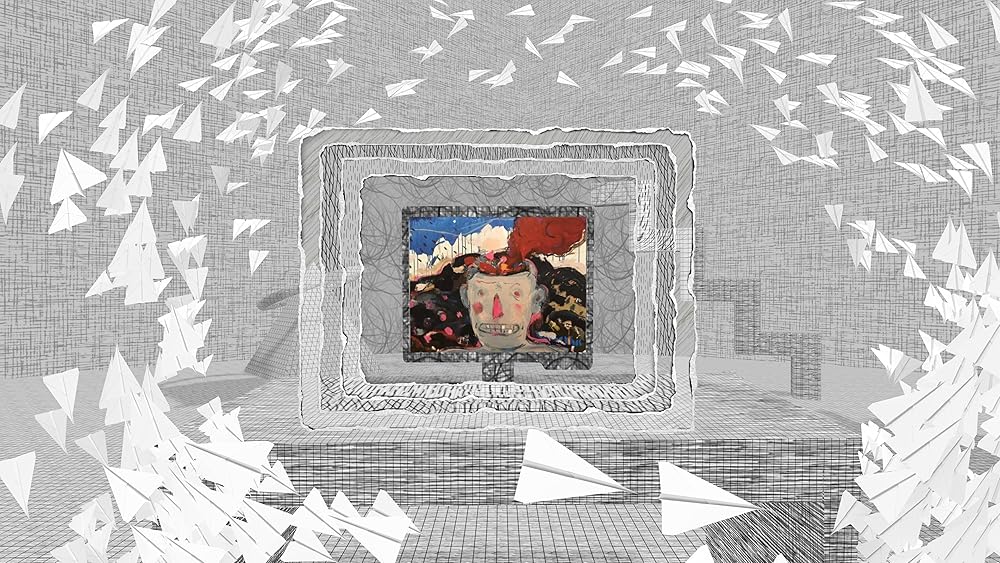
All I Know About Teacher Li tells the story of Teacher Li through the medium of VR. The key haptic feature and central metaphor of the piece is an interactive throwing gesture of an origami object – first a white sheet shaped as a paper plane, later a blue crane bird – into the 360-degree space. These objects resemble posts made to the social media platforms Weibo and Twitter. The VR’s creator Zhuzmo begins to recount the story of Teacher Li’s Weibo account in their own words, and the user is invited to throw several of Li’s posts into the space, only for them to be knocked to the side by a giant eye that has appeared in the sky – the logo of Weibo. As the user repeatedly experiences the bodily frustration of the failure of their invited gesture, narrator-Zhuzmo notes that this is akin to the reality of living in China. Eventually, Teacher Li moves to Twitter, which is marked by a transition that pulls the user from one spatiality (a grey box symbolizing the Chinese internet) to another boxed space where blue origami Twitter birds soar all around. Here, the haptic feature of throwing does work, reinforcing on a bodily level what the relative freedom of the non-Chinese web for Teacher Li might feel like.
Zhuzmo recounts how Teacher Li begins to heavily repost messages from his followers in China. In the middle of the Twitter spatiality, underneath its interface, the Weibo eye still looms. From it, paper planes fly in that open up as messages from mainland China about what is occuring: video footage of barred doors and windows, people locked inside their homes without food or out of hospitals, eventually suicides. While the spatial and haptic design of the VR environment is build to affectively enclose the user in both a comforting and a playful manner, the story simultaneously speaks of enclosure as oppression and suffering. This juxtaposition reinforces the eventual emotional catharsis as Zhuzmo reveals the white paper planes the user has been trying to throw as the same white sheets of protest that began to occur across China and the world and were exacerbated by Li’s posting. They implore the user to keep their (online) activism going as well and to not get complacent, because just like with Teacher Li, it might make a real difference.
Student reactions
Below, we think through three key dimensions of All I Know About Teacher Li and the way our students reacted to these in their reflective papers written after the screening.
1. Immersion, enclosure and corporeal awareness
Almost all students noted being highly aware of the technology through which they were brought into Teacher Li. For some this was an exciting aspect: one student noted how watching other students being onboarded into the VR made her highly conscious of a feeling she was about to enter another world, while another noted that the excitement about the technology was so distracting that it initially overshadowed the storytelling and led to her struggling to emotionally connect to the piece. Others experienced awareness of the technological as a more negative barrier: various people noted the brick-like quality of the headsets, and becoming nauseous or overwhelmed by the newness of the 360-degree storytelling mode.
These reactions are not surprising to us. Across various screenings we have hosted over the last two years, we have experienced participants coming out of headsets with looks of either astonishment or frustration. In aftercare conversations, we note that most participants speak primarily about the experience of the technology, not the story. This is consistent with findings from Xu and Zhang (2022), who observed from focus group research that participants concentrated solely on the “filmic and dramatic spectacularity brought by the novel VR technology” (192). This tells us that despite the hyped immersive promise of VR, in many ways the opposite occurs: users are more aware of their own corporeality, more aware of the mediating technological device sitting on their face, and more aware of the artifice when a disconnect occurs between them.
Together with Mandy Rose, we selected Teacher Li precisely because we feel it consciously reworks some of the flaws of the technology to its advantage. Many early VR built their aesthetics on a logic of immediacy, of being directly transported into another, often more harrowing, world such as the refugee camp in Clouds over Sidra (2015), the frontlines of war in The Fight for Fallujah (2016)or the US-Mexican border in Carne y Arena (2017). These pieces relied on ‘fantasy of transportation’ (Messeri 2024), a lofty promise that VR technology could make the mediating frame disappear and simulating reality to the extend that users would feel like they were ‘truly there’. Inspired by this promise, many VR filmmakers ignored ongoing user feedback about nausea and uncomfortable headsets, and developed a realist grammar focused around emplacing users as close to the action as possible within harrowing spatialities.
Teacher Li’s visual grammar departs from precisely the opposite move: rather than seeking to make the frame disappear, it centralizes the interface and marks its boundaries as uncomfortably enclosed rather than pleasurably infinite. For our students too, the awkwardness of the technology drew attention to the fact that they were not opening up to another world at all, but were rather being oppressively enclosed by one. Teacher Li’s spatial design is employed to politicize this discomfort. Moreover, as users, we are not asked to imagine ourselves as being ‘truly there’ in China – we are asked to imagine ourselves as being inside a computer, as indeed we quite literally are. We access the footage of suffering precisely like how both Zhuzmo and Teacher Li did, mediated by a visibly filtered multiplicity of interfaces, VPNs, social media UI, grainy screenshots and phone-shot camera footage.
2. Interactivity, disaffordance and haptic metaphors
Despite discomfort with the technology, the students all picked up on the central haptic feature of Teacher Li. Here too, many focused their writing around when things did not work. The playfulness of the gesture invited experimentation that the computational design resisted: throwing a plane left, right or behind did not work, as the animation followed a pre-set design. Several students reflected on these instances. One noted that while in VR, interactivity and immersion become interdependent and thus vulnerable to failure. For this student, the failure frustrated them and highlighted the constructed nature of the world. Despite the many layers of mediated artifice and graphic abstraction and their political intention, for this student we deduce that the most important part of the experience was still for the technology to appear natural, to fulfill their playful expectation of a game environment that offers the pleasure of total control.
Even if, as researchers, we sometimes frustratedly want to tell our audiences ‘well just ignore that, focus on the story!’ when they get stuck on system failures, there is a meaningful tension to explore here. As an interactive gamic technology, VR not only promises a fantasy of transportation but also a fantasy of spatial domination and control. Games constitute “theatre(s) for asserting dominion over space through the player’s mastery of gameplay” (Murray 2018, 143), wherein the system is designed to make players experience pleasurable control over the spatiality they inhabit. VR technology, also characterized by a virtual spatiality, controllers and interactivity, seems to come with a similar expectation from its users. We would argue that Teacher Li mines this expectation by reversing it: it employs disaffordance and failure as a metaphor for the experience of government censorship, letting users affectively experience the irritation of not getting what they want. On one level, this is done through the conscious design of the swatting Weibo eye. However, we might argue that Zhuzhmo’s choice to not build in the procedural affordance to throw airplanes in other directions, to refuse this playful dominion of the space by the user and enforce instead only the way they want to tell the story, achieves a similar, if not stronger, affect.
In her lecture, Mandy Rose noted: “Immersants aren’t told what to do or what to think by a narrator. Visuals and sound are important dimensions of the works, but the works can’t be understood through these alone” (Rose, 2025). Film scholar Laura Marks (2000) called the forms of knowledge derived from embodiment ‘tactile epistemologies’”. For Rose, these tactile epistemologies “conceive of knowledge as something gained not on the model of vision, with its connotations of dominance, but through physical contact” (Marks 2000, quoted in Rose 2025). We would argue that the tactile epistemologies of Teacher Li reverse the two core characteristics of VR – immersion as enclosure, interactivity as disaffordance – to experientially reinforce the feeling of oppression without tricking the user into the improper and spectacularized feeling of having gained that knowledge through a first-hand experience.
3. Modalities of care and resistance
A third and final strand of observation we might draw from the student reactions is their considerations regarding how Teacher Li asks them to care. Despite various frustrations, the students largely picked up on and appreciated how Teacher Li moves away from the extractive practices of early VR pieces that revolved around the spectacularized modality of momentarily being inserted into the worlds or bodies of suffering people. One of the students, for example, thought along with Mandy Rose’s desire to see VR be created with a more equal, co-creative ethos, noting that the use of footage captured by citizens consitutted a mode of co-creation that resisted appropriative tendencies and rather positioned Zhuzmo and Teacher Li as amplifyers and collaborators of the original voices of dissent. Another, however, worried for the safety of those depicted in the footage as a result of gaining visibility through the VR’s platform and wondered whether it was ethical to share the footage without blurring all the faces.
One paper, written by Chen Fan (2025), stood out to us in particular for their poignant reflections on care and resistance. Written from experiencing of having themselves lived through the pandemic in China, Fan laid out a careful critique of Teacher Li for reinforcing a particular experience of oppression that they did not personally share, particularly in the form of the larger-than-life swatting, oppressive Weibo hand. While undeniable that during the lockdown period there was an intensive regulation of speech, for them, as one of many ordinary users, it was always unclear whether posts had been shadow-banned or not, leading rather to a deep sense of insecurity, self-surveillance, and anxiety surrounding the invisible controlling hand hanging over them at all times. For them, the representations felt somewhat reductive compared to the lived reality, but they conceded that the simplicity of the metaphor might be necessary to draw in the predominantly Western audience. Dissatisfied with this answer, they pondered whether VR technology might instead be used to address the narrative blind spots that Western media often leave. They wrote:
As Tan (2024) notes, international reporting on Chinese queer activism often focuses on state repression rather than on how activism emerges and evolves. In such framings, the potential for gradual, negotiated forms of resistance, a “slow resistance”, is frequently obscured in favor of narratives about authoritarian decline. Yet activism, especially under authoritarian contexts, operates through slow resistance: gradual coalition-building, negotiation, small-scale subversions, and temporally extended processes of political engagement. I began to wonder: could VR move beyond the paradigm of “intense sensory experiences” that Nakamura (2020) critiques, and instead foster slow, reflective forms of witnessing more attuned to the temporality of activism itself? Instead of striving for immediacy and emotional intensity, could VR help cultivate deeper and more sustained engagement with the multi-layered and temporally extended nature of grassroots activism?”
We leave these reflections with this provoking question in mind.
Bibliography
- Xu, Zhe, and Mengrong Zhang. 2022. “The ‘Ultimate Empathy Machine’ as Technocratic Solutionism? Audience Reception of the Distant Refugee Crisis through Virtual Reality.” The Communication Review 25 (3–4): 181–203.
- Murray, Soraya. 2018. On Video Games: The Visual Politics of Race, Gender and Space. International Library of Visual Culture 27. London New York: I.B.Tauris.
- Rose, Mandy. 2025. Virtual Realities: Documentary’s Immersive Turn. Lecture given at Utrecht University, May 15 2025.
- Marks, Laura U. 2000. The Skin of the Film. Intercultural Cinema, Embodiment, and the Senses. Durham and London: Duke University Press.
- Fan, Chen. 2025. Reflections on VR’s Role in Representing Activism: Experiencing All I Know About Teacher Li. Student paper.
- Nakamura, L. 2020. Feeling good about feeling bad: Virtuous virtual reality and the automation of racial empathy. Journal of Visual Culture, 19(1), 47-64.
- Tan, J. 2024. Slow resistance: Feminist and queer activism in ‘illiberal’contexts. European Journal of Cultural Studies, 13675494241286987.